

Private Label Smart Cat Litter Boxes: Logo, Packaging and App Customization Options
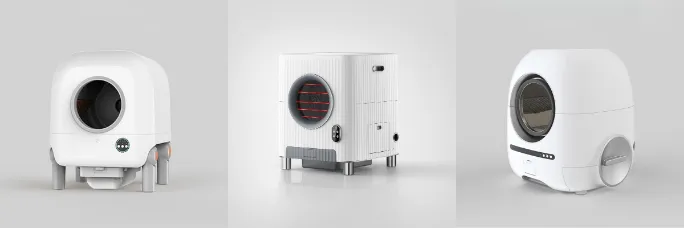
Private label smart cat litter boxes give brand owners, DTC brands and Amazon sellers a faster route into a technically demanding pet product category. Instead of developing every structure, electronic component and app function from the beginning, buyers can start with a mature platform and customize the parts that customers actually see and use.
However, “private label” can mean anything from adding a logo to developing a dedicated app experience. The cost, minimum order quantity, testing workload and launch timeline change substantially as the project moves from light branding to deeper product development.
Smart cat litter boxes also require a different customization approach from simple pet accessories. They combine a large housing, moving parts, motors, safety sensors, waste collection, cleaning logic, electronic controls and, on connected models, app functions. As a result, visual changes must remain compatible with physical safety, cleaning performance, packaging protection and after-sales support.
This guide explains the main logo, packaging, app, safety and appearance customization options for buyers selling in the United States and Europe. It also shows how to define a practical private label scope before requesting samples or quotations.
- Why Smart Cat Litter Boxes Need a Category-Specific Private Label Plan
- Four Levels of Smart Litter Box Customization
- 1. Logo Customization Options
- 2. Packaging Customization for Protection and Conversion
- 3. App Branding and Interface Customization
- 4. App Alerts Brands Commonly Request
- 5. Safety Functions: What Can and Cannot Be Customized
- 6. Color and Exterior Appearance
- 7. Structural and Feature Customization
- 8. Custom Accessories and Product Bundles
- 9. How Customization Affects MOQ, Cost and Lead Time
- 10. Sample Validation Before Mass Production
- 11. Priorities by Buyer Type
- Private Label Smart Litter Box Project Checklist
- Build a Private Label Smart Litter Box Around Real Buyer Value
Why Smart Cat Litter Boxes Need a Category-Specific Private Label Plan
A generic private label checklist is not enough for an automatic litter box. For example, changing a product color may affect multiple plastic parts, while changing an entry structure may influence molds, assembly and user access. Likewise, a new app alert is only possible when the hardware can detect the relevant condition and the firmware can send reliable data.
In addition, the product's size and value make packaging especially important. A cosmetic scratch, displaced component or cracked housing can create an expensive return even when the cleaning function works correctly.
Therefore, buyers should plan customization around four business goals:
- Build a recognizable brand identity
- Match the product to the target market and sales channel
- Protect the product during fulfillment and final delivery
- Preserve reliable safety, cleaning and app performance
The strongest private label projects do not add every available feature. Instead, they choose the changes that improve market positioning without introducing unnecessary technical or operational risk.
Four Levels of Smart Litter Box Customization
Before discussing individual options, buyers should identify the appropriate customization level.
| Customization Level | Typical Scope | Best Fit | Main Planning Issue |
|---|---|---|---|
| Standard product | Existing model, color, app and packaging | Early product evaluation | Confirm the exact supplied configuration |
| Light private label | Product logo, labels, manual and limited packaging changes | Small market tests and first launches | MOQ may differ by branding item |
| Enhanced private label | Custom box, color selection, accessory bundle and supported app branding | Growing brands with a defined position | More approvals, materials and testing |
| OEM/ODM development | Structural, firmware, feature, app or tooling changes | Established brands with a product roadmap | Higher development commitment and technical validation |
For many first launches, light or enhanced private label is the practical starting point. Meanwhile, deeper OEM/ODM development is more suitable when a brand has validated demand, a clear feature brief and enough time for engineering and testing.
1. Logo Customization Options
Logo customization is usually the most visible first step. Nevertheless, placement and production method should be selected around the product structure rather than appearance alone.
Possible logo locations may include:
- Front housing or control panel area
- Side panel
- Waste-bin cover
- Removable accessory
- Product rating or identification label
- Retail packaging and shipping carton
- User manual and quick-start guide
- App opening screen or device page, when supported
The logo should not cover sensors, ventilation openings, buttons, screens, warning labels or moving interfaces. In addition, it should remain clear after normal cleaning and handling.
What Buyers Should Confirm
Ask the supplier to clarify:
- Available logo positions for the selected model
- Printing, labeling or other supported application methods
- Artwork format and color requirements
- Maximum logo size
- Color contrast on the chosen housing
- Resistance to routine cleaning
- MOQ and setup cost by logo method
- Sample approval process before mass production
For example, a simple one-color logo may fit an initial Amazon launch, whereas an established DTC brand may need product, packaging, manual and app branding to follow one visual system. Therefore, the correct choice depends on how much brand consistency the channel requires.
2. Packaging Customization for Protection and Conversion
Packaging has two jobs: it protects the smart litter box and communicates the offer. Focusing on only one can create problems.
An attractive box with weak internal support may fail during e-commerce delivery. By comparison, highly protective packaging with unclear product information may create customer confusion, unsuitable purchases and avoidable returns.
Outer Packaging Options
Private label packaging may include:
- Brand name and logo
- Product name and model
- Product images
- Key feature explanations
- Color and variant identification
- Included accessory list
- Barcode and SKU labels
- Handling or safety information
- Destination-market labeling elements
- Multi-language content where required
All text and symbols should match the exact product configuration. For this reason, buyers should avoid placing unsupported functions, app screens or performance claims on the box before the sample is validated.
Internal Protection
A smart cat litter box may contain removable bins, liners, mats, adapters or other accessories. Consequently, each part needs a defined packing position and enough protection to prevent movement or surface damage.
Buyers should review:
- How the main housing is supported
- Whether moving parts are secured for transport
- Protection for screens and finished surfaces
- Accessory placement and identification
- Cable and adapter organization
- Resistance to compression and normal delivery handling
- Carton opening method and product removal experience
Packaging validation should reflect the intended fulfillment route. For example, parcel delivery to an Amazon or DTC customer creates different handling conditions from palletized delivery to a retail distributor.
Manuals and Setup Materials
The box is only the beginning of the customer experience. Therefore, private label packaging should also include clear setup, use, cleaning and troubleshooting information.
Depending on the model and market, materials may include:
- Printed user manual
- Quick-start guide
- App download and pairing guide
- Cleaning and maintenance instructions
- Litter compatibility guidance
- Safety information
- Troubleshooting steps
- Warranty or customer-support information
For European distribution, language needs can differ by destination country and channel. Likewise, U.S. retail and marketplace programs may have their own documentation and labeling expectations. Buyers should have the final configuration reviewed for the exact destination and platform rather than treating one packaging file as universal.
3. App Branding and Interface Customization
For a connected smart litter box, the app becomes part of the product. Customers may use it to review device status, receive alerts, manage supported cleaning settings or check usage information. As a result, an unclear app experience can weaken an otherwise well-designed product.
App customization can range from light branding to a dedicated software project.
Light App Branding
Depending on the existing platform, light changes may include:
- Brand logo
- Product or device name
- Device icon
- Selected interface colors
- Supported language text
- Brand contact or help information
- Customized setup guidance
This route can be useful for brands that want visual consistency while retaining a mature app framework. However, buyers should confirm whether the app is shared, white-label or dedicated and who is responsible for future updates.
Deeper App Customization
More extensive requests may involve:
- Revised navigation or interface layout
- Custom notification wording
- Different data presentation
- Feature activation or removal
- Account and device-sharing workflows
- Dedicated app-store listing
- Backend or cloud-service changes
- Integration requirements
These changes may affect development fees, MOQ, testing, privacy documentation, app-store processes and long-term maintenance. Therefore, “we need our own app” should be converted into a detailed functional brief before the supplier estimates feasibility.
4. App Alerts Brands Commonly Request
Alerts can make a smart litter box more convenient, but only when they are linked to dependable product data. A marketing request for an alert does not automatically mean that the selected hardware can support it.
Depending on the exact model and configuration, buyers may discuss alerts for:
- Cleaning cycle completion
- Device fault or interrupted cycle
- Waste-bin status
- Consumable or maintenance reminder
- Device offline status
- Abnormal operating condition
- Supported pet-use or weight-related information
For example, a waste-bin alert requires an appropriate detection method and validated logic. Similarly, pet-use data depends on the sensors, firmware and measurement design of the specific product.
For this reason, buyers should ask the supplier to demonstrate how each alert is triggered. They should also verify the wording, response time, reset condition and recommended user action.
Notification Design Questions
- What physical event or sensor triggers the notification?
- Is the message informational, a maintenance reminder or a safety warning?
- What should the user do after receiving it?
- Can the alert be enabled or disabled?
- Does it remain available if the device is offline?
- Is the event recorded in the app?
- Can notification text be translated or branded?
- Has the alert been tested on the intended app and firmware version?
Useful notifications reduce uncertainty. In contrast, frequent false alerts can increase support requests and damage customer confidence.
5. Safety Functions: What Can and Cannot Be Customized
Safety is not a decorative feature. In an automatic litter box, it depends on the combined performance of physical design, sensors, motor control, firmware logic, assembly and testing.
Depending on the selected model, safety-related functions may involve:
- Detection intended to prevent operation when a pet is present
- Monitoring of operating resistance or abnormal movement
- Controlled stopping or interruption logic
- Physical spacing and moving-part protection
- Entry and interior geometry
- Control lock or unintended-operation prevention
- Fault indication and user guidance
However, availability and implementation differ by product platform. Buyers should never assume that changing app wording or adding a notification creates a new hardware safety capability.
A Better Safety Review
Ask the manufacturer to explain and demonstrate:
- Which sensors are used and where they are located
- What conditions prevent or stop a cleaning cycle
- How the product responds after an interruption
- Which fault conditions are displayed locally or in the app
- How safety functions are checked during production
- Whether the requested exterior or structural changes affect detection
- Which test records or product documents are available for the exact model
In addition, test the approved sample using the intended firmware and configuration. If a safety-related change is requested, the affected functions should be re-evaluated before mass production.
Most importantly, marketing copy, manuals and app messages should describe the actual validated behavior. Absolute claims such as “completely risk-free” should not be used.
6. Color and Exterior Appearance
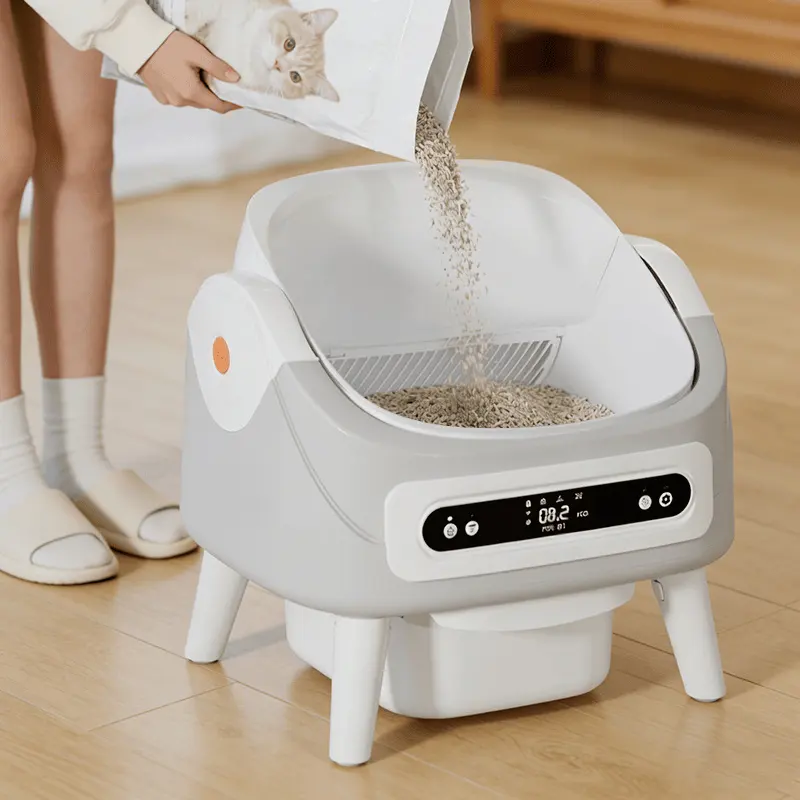
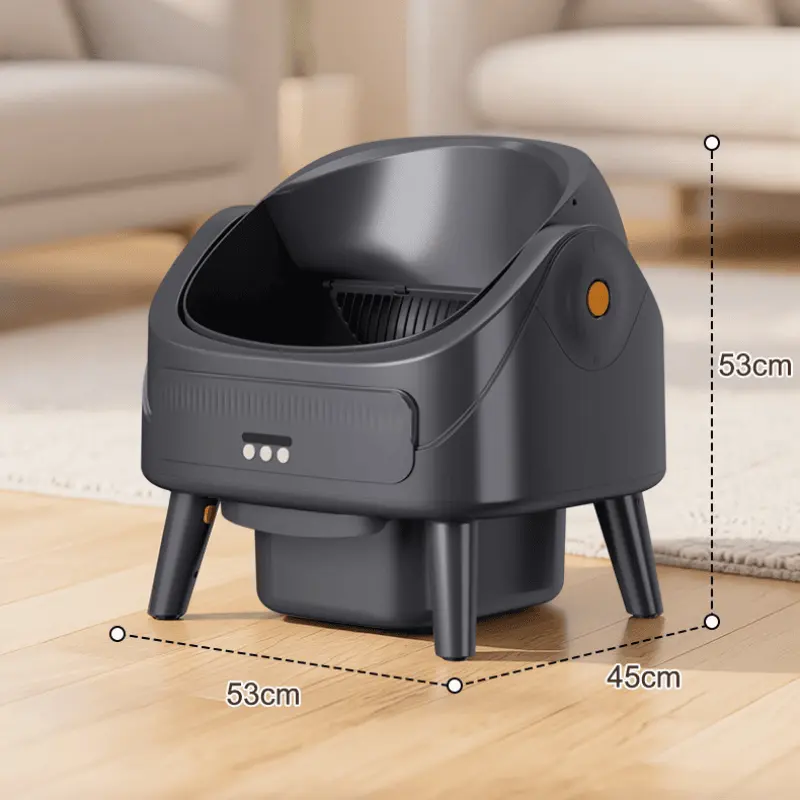
Smart litter boxes are large products used inside the home, so their appearance can strongly influence purchase decisions. Brands may want the unit to fit minimalist interiors, a premium appliance position or a recognizable product family.
Possible appearance options include:
- Selection from standard housing colors
- Custom color matching
- Contrasting trim or panel colors
- Surface texture or finish
- Control-panel graphics
- Waste-bin or entry details
- Coordinated mat, liner or accessory colors
Using an existing color generally requires less development than creating a custom material color. Meanwhile, a new finish may affect molding, surface consistency, scratch visibility and cleaning expectations.
Questions to Ask About Color
- Which colors are already in regular production?
- Is the custom color based on a code or an approved physical sample?
- Which parts can be color-matched?
- Will different materials show the color differently?
- What MOQ applies to each custom-colored component?
- Does the color change affect lead time?
- How will color consistency be checked in mass production?
For an initial launch, an existing neutral color with distinctive packaging and branding may offer a balanced route. Later, a custom exterior can support stronger differentiation once demand is validated.
7. Structural and Feature Customization
Some requests move beyond private label and into product development. Examples may include changes to entry height, interior space, waste handling, control layout, odor-management components, accessory bundles or cleaning logic.
Structural changes can affect molds, assembly, packaging and safety behavior. Likewise, firmware changes may influence motor operation, app data or alerts. Consequently, these requests need engineering review rather than a simple quotation adjustment.
Before requesting a structural or functional change, define:
- The user problem being solved
- Target cat size or household scenario
- Current product limitation
- Required result
- Must-have versus optional features
- Acceptable development budget
- Expected order volume
- Target launch date
- Validation method
A reference image can help explain the idea, but it is not a complete specification. Therefore, buyers should work with the manufacturer to translate the concept into dimensions, functions, materials and test criteria.
8. Custom Accessories and Product Bundles
Brand differentiation can also come from the complete offer rather than the main machine alone. Depending on product compatibility, a private label bundle may include selected accessories or consumables.
Possible discussions include:
- Litter-catching mat
- Waste-bin liners
- Odor-management accessories
- Cleaning tools
- Power adapter and plug configuration
- Printed setup materials
- Replacement or maintenance items
However, every included item affects packaging space, weight, labeling and replenishment. As a result, buyers should confirm whether accessories are included in the standard configuration, optional or sourced separately.
For DTC brands, a well-designed bundle can support a stronger launch offer. By comparison, Amazon sellers may prioritize a clear included-parts list and compact, protective packaging to reduce customer confusion.
9. How Customization Affects MOQ, Cost and Lead Time
Each customization layer has a different commercial impact. Logo printing, custom cartons, plastic colors, app changes and structural development may all have separate minimum quantities.
Likewise, lead time can include artwork approval, sample preparation, component purchasing, software changes, testing, packaging production, assembly and inspection. A supplier's standard-product timeline should not be assumed to apply to a customized version.
Buyers should request a breakdown showing:
- MOQ by model, color, logo and packaging version
- One-time setup or development charges
- Sample cost and sample preparation stage
- Artwork and specification approval deadlines
- Material procurement period
- App or firmware development and test period
- Production and inspection period
- Packaging completion and shipment-ready definition
Moreover, ask what starts the lead-time clock. The schedule may depend on deposit receipt, final artwork approval, sample confirmation or completion of several conditions.
Specific MOQ, price and timing should always be confirmed for the selected model, quantity, customization scope and requested production window.
10. Sample Validation Before Mass Production
A private label sample should represent the agreed production standard as closely as possible. Otherwise, a visually approved sample may leave important app, safety or packaging questions unresolved.
Product and Appearance
- Correct model and configuration
- Housing color and surface finish
- Logo size, color and position
- Assembly fit and visible workmanship
- Included parts and accessories
Operation and Safety
- Normal setup and cleaning workflow
- Supported sensor responses
- Stop, interruption and recovery behavior
- Local controls and fault indication
- Noise and movement under intended use conditions
- Cleaning and maintenance access
App Experience
- Download and account process
- Device pairing and reconnection
- Supported alerts and their trigger conditions
- Cleaning controls and records, when available
- Language and branded elements
- Device sharing and support flow, when included
Packaging and Documentation
- Product protection and part placement
- Box artwork and variant identification
- Manual and quick-start accuracy
- App QR code and setup steps
- Labels, warnings and destination-market information
Once the sample is approved, the final specification, artwork, firmware or app version, accessories and test checklist should be recorded. Therefore, mass production can be inspected against a shared reference rather than memory or chat messages.
11. Priorities by Buyer Type
Brand Owners
Brand owners usually need consistency across the product, packaging, app and customer support. For this group, a clear product roadmap helps separate launch requirements from future upgrades.
DTC Brands
DTC buyers control more of the customer journey. Consequently, setup content, app onboarding, unboxing, support information and replacement accessories may be as important as the exterior logo.
Amazon Sellers
Amazon sellers should pay close attention to packaging protection, variant identification, included accessories, setup clarity and return reasons. In addition, product listings must match the supplied function and exact configuration.
Although priorities differ, all three buyer types benefit from starting with a stable product platform and a controlled customization scope.
Private Label Smart Litter Box Project Checklist
Before requesting a quotation, prepare:
- Target market and sales channel
- Selected model or required product concept
- Expected trial and repeat-order quantities
- Brand logo in an editable format
- Preferred logo location and color
- Standard or custom product color
- Packaging design scope
- Included accessories and bundle plan
- Required manual languages
- Necessary app functions and alerts
- Light branding or dedicated app expectation
- Safety functions that must be demonstrated
- Product, app and packaging acceptance criteria
- Target launch and required arrival window
- Destination-market and platform documentation needs
- After-sales and spare-parts expectations
This information helps the supplier distinguish readily available options from changes that need engineering, software, tooling or material review. As a result, the quotation and development plan can be more accurate.
Build a Private Label Smart Litter Box Around Real Buyer Value
A successful private label smart cat litter box combines brand differentiation with stable product performance. Logo, packaging and color create recognition, while a clear app experience and dependable alerts improve daily use. Meanwhile, physical safety functions, production testing and protective packaging help control after-sales risk.
The right customization level depends on the brand's launch stage, channel, quantity and product roadmap. For an early market test, light branding and mature functions may be enough. In contrast, an established brand may be ready for deeper app, appearance or structural development.
CKX Pet supports global B2B buyers with smart pet product sourcing, small-batch trial orders, ready-stock wholesale, light customization and OEM/ODM cooperation. Available private label options, MOQ, development scope, app functions, documents and lead time depend on the selected smart litter box model, configuration, quantity and destination market.