


MOQ, Lead Time, and Production Capacity Explained for Smart Cat Litter Box Buyers

- Introduction
- Why MOQ Matters More Than Many Buyers Expect
- Lead Time Is a Supply Chain Issue, Not Just a Factory Promise
- Production Capacity Defines Whether the Supplier Can Support Real Growth
- How MOQ, Lead Time, and Capacity Work Together
- What B2B Buyers Should Review Before Placing a Smart Cat Litter Box Order
- Why Small Trial Orders Can Be a Smart Buying Strategy
- How a Reliable Supplier Supports B2B Buyers Beyond Manufacturing
- Recommended Sourcing Approach for Smart Cat Litter Box Buyers
- FAQ
- Conclusion
Introduction
For B2B buyers sourcing a smart cat litter box, three questions usually matter more than anything else: What is the MOQ? How long is the lead time? Can the supplier handle stable production capacity?
These are not just commercial terms. They directly affect your launch plan, inventory turnover, cash flow, and market entry strategy. For Amazon private label sellers, regional distributors, and brand owners, even a strong product can become a weak business decision if the supplier cannot support the right order volume, delivery schedule, and customization requirements.
In this article, we explain how MOQ, lead time, and production capacity should be evaluated when sourcing smart cat litter boxes for wholesale or OEM/ODM projects. If you are comparing suppliers, this framework can help you make a more informed purchasing decision.
Why MOQ Matters More Than Many Buyers Expect
MOQ, or Minimum Order Quantity, is often the first commercial filter in a sourcing inquiry. But for smart cat litter box buyers, MOQ is not only about price. It also reflects the supplier’s manufacturing structure, component sourcing strategy, and willingness to support different business models.
A low MOQ may be helpful for:
- market testing
- small batch launch
- Amazon or DTC validation
- regional pilot programs
- early-stage brand development
A higher MOQ may be more suitable when:
- the product requires custom mold changes
- packaging is fully branded
- firmware or app customization is needed
- certification and compliance documentation are project-specific
- buyers need a stable wholesale replenishment plan
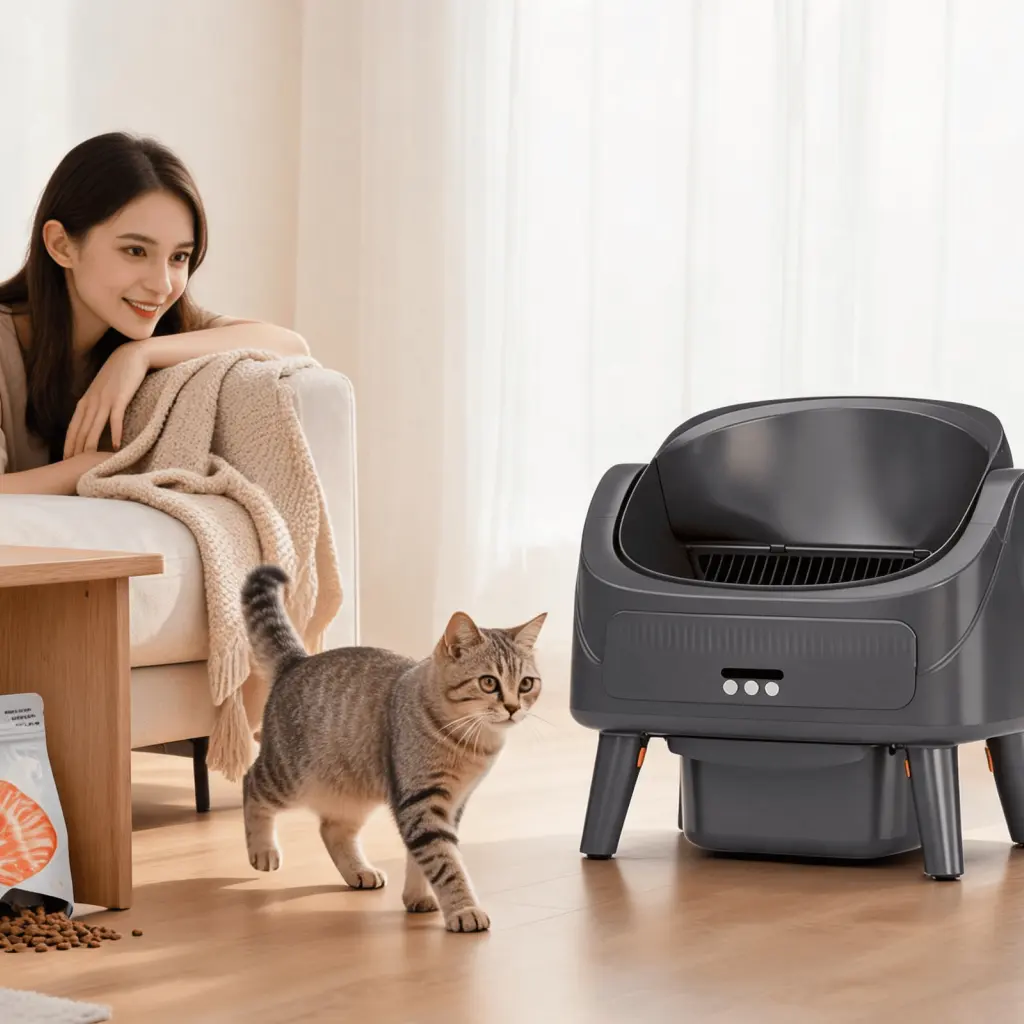
For smart cat litter box procurement, MOQ should always be reviewed together with product configuration. A supplier may offer a lower MOQ for stock models, but require a higher quantity for OEM branding or customized functions.
What usually affects smart cat litter box MOQ?
Several factors can influence the final MOQ:
- Product structure and materials
- Motor, sensor, and electronics sourcing
- Packaging customization
- Logo printing or private label requirements
- Color or surface finish changes
- Compliance and certification scope
- Component stock availability
- Production line setup cost
For B2B buyers, the right question is not only “What is your MOQ?” but also “What is the MOQ for this exact configuration?”
Lead Time Is a Supply Chain Issue, Not Just a Factory Promise
Lead time is another critical factor in smart cat litter box sourcing. For wholesale orders, lead time determines when your inventory reaches the market, how quickly you can respond to demand, and whether your sales channel stays in stock.
Lead time is usually influenced by:
- order size
- customization scope
- raw material and component availability
- test and inspection requirements
- packaging complexity
- shipping method and destination
Typical lead time scenarios
Although actual timelines depend on each project, smart cat litter box lead time generally falls into these categories:
1. Stock orders
If the supplier has finished goods or semi-finished stock available, delivery can be significantly faster.
2. Light customization orders
Orders with logo printing, branded packaging, or minor specification adjustments usually require extra processing time, but may still remain relatively efficient.
3. OEM/ODM development orders
If your project involves custom features, firmware adaptation, packaging development, or new compliance documentation, lead time will be longer because the project may require sample confirmation and additional production setup.
What buyers should ask about lead time
To avoid surprises, B2B buyers should ask suppliers:
- Is the lead time calculated from deposit payment, artwork approval, or sample confirmation?
- Does the timeline include packaging production?
- Are key components in stock?
- Is the lead time different for first orders and repeat orders?
- What happens if certifications or testing are required before shipment?
A serious supplier should be able to explain the lead time structure clearly, not only provide a rough date.
Production Capacity Defines Whether the Supplier Can Support Real Growth
For smart cat litter box buyers, production capacity matters just as much as product quality. A supplier may be able to produce a sample or even a small trial order, but that does not automatically mean they can support ongoing wholesale orders.
Production capacity should be evaluated from both a monthly output and a process stability perspective.
What production capacity tells you
A supplier’s production capacity reflects:
- number of assembly lines
- labor allocation
- test and QC capability
- component inventory control
- packaging workflow
- ability to handle repeat orders
- flexibility for seasonal demand spikes
In the smart pet product category, stable production capacity is especially important because litter boxes include electronics, sensors, motors, structural parts, and packaging coordination. One bottleneck in the supply chain can affect the entire order schedule.
Questions to ask about capacity
Before placing a wholesale order, buyers should ask:
- What is the monthly output for this model?
- Can you handle repeat bulk orders consistently?
- How many production lines are allocated to this product category?
- What is your quality inspection process?
- Can you support peak-season replenishment?
- How do you ensure stable component supply?
If a supplier cannot answer these questions clearly, capacity risk may be higher than it appears.
How MOQ, Lead Time, and Capacity Work Together
These three factors are closely connected.
A lower MOQ is often easier for stock products, but a short lead time may depend on whether the supplier has sufficient capacity and inventory.
A customized OEM order may require a higher MOQ, a longer lead time, and more structured production planning.
A high-capacity factory may be able to support larger wholesale orders more reliably, but buyers still need to confirm whether the actual line capacity matches the supplier’s promise.
For smart cat litter box procurement, the best supplier is not always the one with the lowest MOQ. It is often the one that can provide the most balanced combination of:
- reasonable MOQ
- predictable lead time
- stable capacity
- consistent quality
- flexible customization
- compliance support
That balance is especially important for brands selling into the EU, US, UK, Japan, and other regulated markets.
What B2B Buyers Should Review Before Placing a Smart Cat Litter Box Order
To reduce sourcing risk, buyers should evaluate more than just unit price.
1. Product consistency
Ask whether the supplier can maintain the same build quality across repeat orders. This is critical for returns, reviews, and brand reputation.
2. Customization capability
Private label buyers should confirm whether the supplier supports:
- logo branding
- packaging customization
- color changes
- firmware or app adjustments
- accessory bundles
- instruction manual localization
3. Compliance readiness
Smart cat litter boxes may require different compliance documents depending on the destination market. Buyers should confirm whether the product can support the necessary standards and documentation for their region.
4. After-sales risk
A low-price supplier with poor QC can create higher total cost through returns, complaints, and channel penalties. Buyers should ask about defect control, inspection procedures, and spare part support.
5. Scalable supply
Even if your first order is small, your supplier should be able to scale with your business. A good wholesale partner should not only handle trial orders, but also repeat replenishment and seasonal growth.
Why Small Trial Orders Can Be a Smart Buying Strategy
Many importers and brand owners prefer to start with a small batch before committing to a larger rollout. This is especially common for:

- new Amazon listings
- regional distribution tests
- retailer pilot programs
- niche DTC launches
- market validation projects
A small trial order can help buyers evaluate:
- product fit in the target market
- packaging response
- customer feedback
- defect rate
- logistics performance
- return frequency
However, trial orders should still be planned with future scale in mind. A supplier that accepts a small MOQ but cannot support follow-up wholesale orders may create supply inconsistency later.
How a Reliable Supplier Supports B2B Buyers Beyond Manufacturing
For smart cat litter box buyers, a supplier should do more than produce units. The supplier should also help reduce sourcing friction across the full project cycle.
A dependable manufacturer typically supports:
- sample development
- technical communication
- OEM/ODM planning
- packaging coordination
- quality control
- stable replenishment
- export documentation support
This is especially valuable for brands that need a practical partner rather than a one-time factory quote.
Recommended Sourcing Approach for Smart Cat Litter Box Buyers
If you are sourcing a smart cat litter box for wholesale or private label sales, a practical evaluation process is:
- Confirm the target market and compliance needs
- Define the required configuration and features
- Ask for MOQ by version, not only by product name
- Review lead time for both first order and repeat order
- Check production capacity and monthly output
- Validate QC process and after-sales support
- Assess whether the supplier can scale with your business
This approach helps buyers compare suppliers more accurately and avoid hidden risks later in the project.
FAQ
Q1: What is the usual MOQ for a smart cat litter box?
MOQ varies by supplier, product structure, and customization level. Stock models usually have lower entry thresholds, while OEM or branded versions often require a higher MOQ.
Q2: Why does lead time differ between suppliers?
Lead time depends on material availability, assembly capacity, customization scope, packaging requirements, and compliance preparation. Suppliers with stronger planning and component control usually offer more stable timelines.
Q3: Can a factory support small trial orders and large wholesale orders at the same time?
A capable factory can often handle both, but buyers should verify whether production capacity is stable enough to support repeat orders, seasonal demand, and multiple SKUs.
Q4: Is a low MOQ always better?
Not necessarily. A low MOQ is useful for testing, but buyers should also consider quality consistency, lead time, compliance, and the supplier’s ability to scale future orders.
Q5: What should I ask before placing a private label order?
You should confirm MOQ, lead time, capacity, customization options, compliance documents, packaging support, and quality inspection standards.
Conclusion
For smart cat litter box buyers, MOQ, lead time, and production capacity are not separate questions. They are part of one procurement decision that affects cost, risk, and long-term supply stability.
The right supplier should offer a commercial structure that fits your launch plan, support your customization needs, and maintain stable production for wholesale growth. For importers, distributors, Amazon sellers, and private label brands, this is the difference between a short-term purchase and a scalable sourcing partnership.
If you are evaluating smart cat litter box suppliers, use MOQ, lead time, and capacity as a framework before comparing unit prices alone.