


How to Ensure Smart Cat Litter Boxes Meet Amazon Compliance Requirements
- Why Amazon Compliance Matters for Smart Cat Litter Box Buyers
- Start with the Amazon Seller Requirements for Smart Cat Litter Boxes
- Product Testing: The Foundation of an Amazon Compliant Smart Cat Litter Box
- What Buyers Should Check Before Ordering in Volume
- How the Right Factory Supports Amazon Compliance
- Common Compliance Mistakes to Avoid
- Best Practice Workflow for B2B Buyers
- FAQ: Amazon Compliance for Smart Cat Litter Boxes
- Conclusion
Selling an Amazon compliant smart cat litter box is not just a product-development task. For B2B buyers, it is a sourcing, testing, documentation, and supply-chain issue that affects launch speed, account stability, and long-term profitability.
Amazon’s marketplace standards place pressure on sellers and brands to prove product safety, reliability, and labeling accuracy before scaling sales. For importers, distributors, wholesalers, and private label brands, the real challenge is not only finding a functional smart cat litter box, but also securing a supply partner that can support Amazon seller requirements with consistent product testing, stable production, and export-ready documentation.
In this guide, we break down the key compliance checkpoints buyers should review before placing orders or launching a smart cat litter box on Amazon.
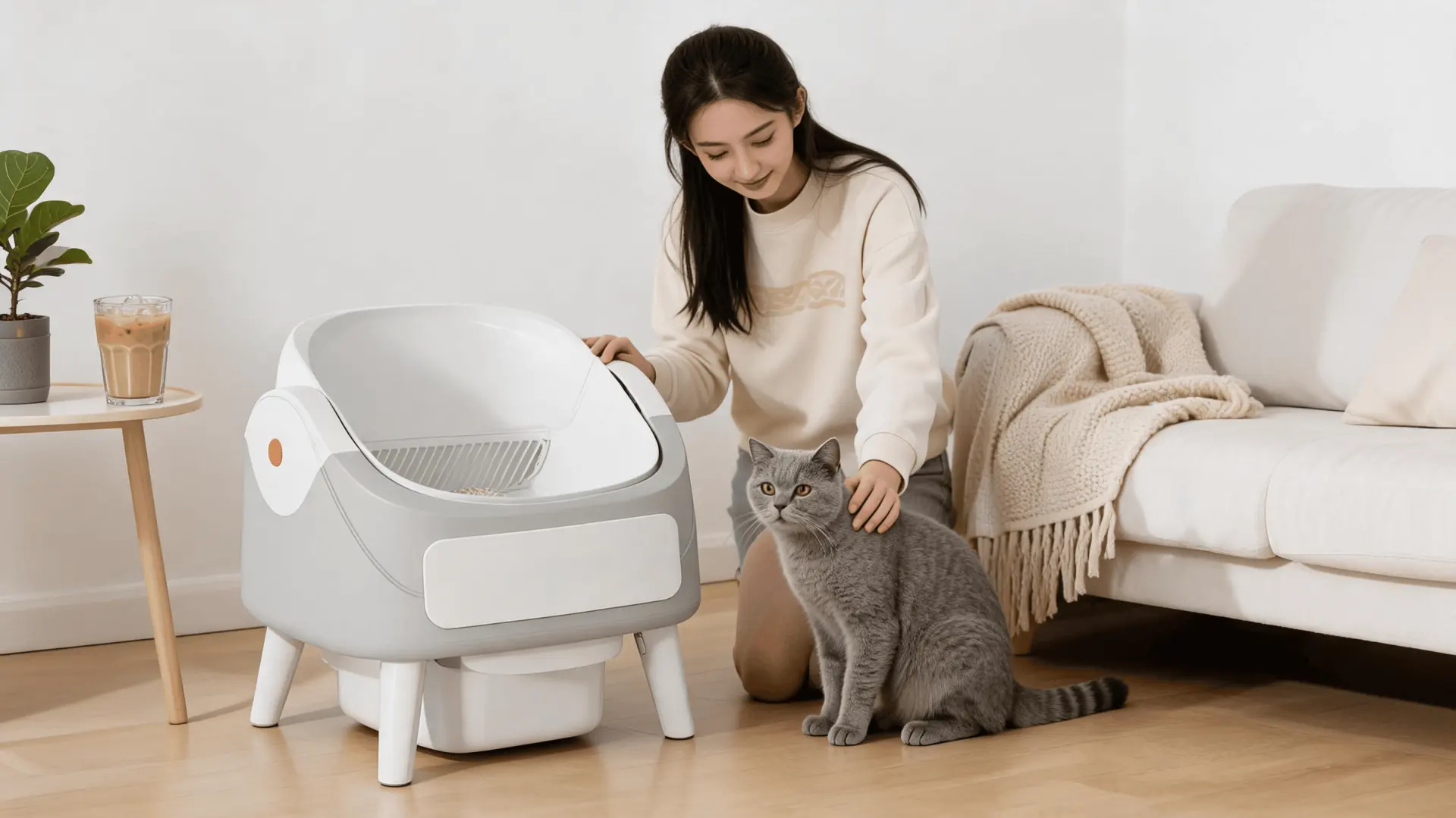
Why Amazon Compliance Matters for Smart Cat Litter Box Buyers
A smart cat litter box usually combines electrical components, motors, sensors, control boards, app connectivity, and in some cases heating or odor-control functions. That means the product can trigger multiple compliance concerns at once.
For B2B buyers, Amazon compliance matters because it directly affects:
- marketplace approval and listing stability
- risk of listing suppression or document requests
- returns, customer complaints, and negative reviews
- liability exposure in target markets
- brand reputation for Amazon FBA and cross-border sales
If you are sourcing a smart litter box for Amazon, compliance should be reviewed before sampling, not after mass production.
Start with the Amazon Seller Requirements for Smart Cat Litter Boxes
Amazon seller requirements are not always identical across marketplaces, but buyers should assume that smart pet products need to demonstrate safety, proper labeling, and product consistency.
At a minimum, procurement teams should confirm:
- the product classification and target marketplace requirements
- whether the model includes electrical, battery, wireless, or heating functions
- whether the product requires third-party lab testing
- whether the packaging and instruction manual meet local language and warning-label expectations
- whether all claims in the listing can be supported by documentation
For a smart cat litter box, the compliance review should be tied to the exact product version. Even a small design change, such as a new adapter, motor, sensor board, or control panel, may require updated testing or documentation.
Product Testing: The Foundation of an Amazon Compliant Smart Cat Litter Box
Product testing is the most important proof point for Amazon compliance. Buyers should not rely on a supplier’s verbal claim that the model is “Amazon ready.”
Instead, ask for a complete testing plan that covers the product’s actual configuration. Depending on the design and destination market, relevant product testing may include:
- electrical safety testing
- EMC/EMI testing for electronic components
- adapter and power supply safety review
- battery-related testing if applicable
- material safety evaluation for plastics and consumables
- durability and lifecycle testing for motors, sensors, and moving parts
- packaging drop testing for export and FBA handling
- labeling and warning-text verification
For B2B procurement, the goal is not to collect certificates for marketing value. The goal is to reduce marketplace risk and confirm that the product configuration matches the test reports.
What Buyers Should Check Before Ordering in Volume
Before approving a smart cat litter box supplier, review more than the sample unit. A supplier that can support Amazon sales should be able to provide a full compliance package and stable manufacturing controls.
1. Confirm the exact product version
Ask whether the sample, test report, and mass-production model are identical. A different motor, board, plug type, or housing material can create compliance gaps.

2. Review the documentation set
A strong supplier should be able to provide:
- test reports
- product specifications
- user manual drafts
- warning labels
- carton and shipping marks
- traceability information
- QC inspection records
3. Verify production consistency
For Amazon and wholesale channels, batch consistency matters. Buyers should confirm that the factory can maintain the same performance level across repeated orders.
4. Check repair and return control
Low defect rates are especially important for bulky smart pet products. Ask about incoming QC, in-line inspection, final testing, and after-sales failure analysis.
5. Match compliance to the target market
A unit prepared for the US market may require a different documentation set than one intended for the EU, UK, Japan, or Korea. The supplier should understand export-market differences and support localized versions when needed.
How the Right Factory Supports Amazon Compliance
A qualified manufacturing partner does more than assemble units. For an Amazon-focused buyer, the supplier should help reduce compliance friction during development, sampling, and launch.
A strong partner typically offers:
- OEM/ODM support for private label and brand customization
- light customization for packaging, colors, and features
- engineering support for compliance-oriented design updates
- stable production capacity for small trial orders and repeat volume
- export-ready quality control processes
- documentation support for marketplace submission and internal audits
For example, if your business needs an Amazon compliant smart cat litter box for a new private label launch, it is safer to work with a factory that already understands testing workflows, packaging rules, and B2B order structures than to start from a consumer-only supplier.
Our own production setup is designed for this type of buyer. With a 7,000㎡ factory, mature production lines, and support for small-batch trials, wholesale supply, OEM/ODM, and light customization, we help B2B customers reduce sourcing risk while maintaining supply stability for market expansion.
Common Compliance Mistakes to Avoid
Many Amazon listing issues come from avoidable sourcing mistakes. The most common ones include:
- ordering from a supplier without verified test reports
- using a sample that differs from mass production
- making performance claims that cannot be documented
- ignoring label and manual requirements
- failing to confirm power supply or plug compatibility
- assuming one certification covers every marketplace
- launching before final QC and carton verification


These mistakes are especially costly for smart pet products because the combination of electronics, moving parts, and shipping sensitivity increases the chance of returns and compliance review.
Best Practice Workflow for B2B Buyers
If you are sourcing a smart litter box for Amazon, a practical workflow looks like this:
- define the target market and sales channel
- confirm the product features and power configuration
- request compliance documentation before sample approval
- review the test scope and test lab details
- verify packaging, manual, and labeling drafts
- validate mass-production consistency
- approve only after final pre-shipment inspection
This process is slower than buying a finished retail product, but it gives Amazon sellers and distributors a far better chance of scaling without avoidable compliance issues.
FAQ: Amazon Compliance for Smart Cat Litter Boxes
What makes a smart cat litter box “Amazon compliant”?
An Amazon compliant smart cat litter box is one that can be listed and sold with the necessary documentation, labeling, and product testing support required by the relevant Amazon marketplace.
Do all smart litter boxes need the same testing?
No. Testing depends on the product design, electrical configuration, battery use, wireless features, and target sales region. Buyers should always match testing to the exact product version.
Can OEM or ODM smart litter boxes be prepared for Amazon?
Yes. OEM/ODM projects can be developed with Amazon seller requirements in mind, as long as the supplier understands compliance planning, documentation, and production control from the beginning.
Why is supplier selection so important?
Because compliance is not only about paperwork. It depends on engineering consistency, material selection, packaging control, and factory-level quality management.
Conclusion
For B2B buyers, building an Amazon compliant smart cat litter box starts with the right sourcing strategy. Compliance should be treated as part of product development, not a last-minute listing task.
The most reliable approach is to work with a supplier that can support testing, documentation, OEM/ODM customization, and stable production at scale. That reduces risk for Amazon launches, wholesale programs, and private label expansion.
If you are evaluating a smart cat litter box project for Amazon or another cross-border channel, contact us to discuss your target market, compliance needs, and customization requirements. We can help you assess the right product structure, documentation path, and supply plan before you place your order.